
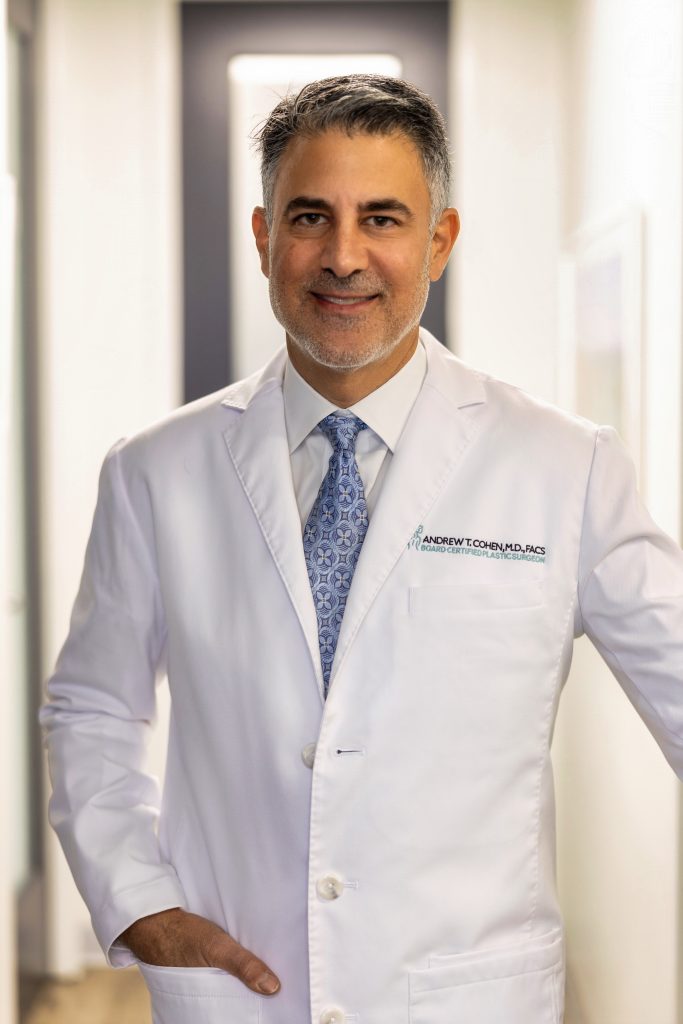
1 – Q) Kindly give our readers an introduction to your business.
A) The practice of Dr. Andrew T. Cohen, MD, FACS is a board-certified plastic surgery practice in Encino, California, serving patients across Los Angeles and the San Fernando Valley, including Calabasas, Sherman Oaks, Westlake Village, and Thousand Oaks. We offer a full range of surgical and non-surgical aesthetic care for the face, breast, and body, including facelift and neck lift, the Luminosity Lift, breast augmentation, breast revision, breast lift and reduction, tummy tuck, mommy makeover, and liposuction.
Our office is located off the 101 freeway and Balboa Boulevard and includes our own QUAD A accredited operating room, so patients have surgery in a private, state-of-the-art setting. We also offer non-surgical treatments and our own physician-formulated skincare line, Cohen MD Skin, to help patients maintain their results. After many years in Beverly Hills, we moved the practice to Encino and operate from one location.
2 – Q) Kindly give us a brief description about yourself.
A) I am a native of Southern California and a board-certified plastic surgeon with more than 25 years of experience in aesthetic and reconstructive surgery of the face, breast, and body. I have been certified by the American Board of Plastic Surgery since 2002 and am a Fellow of the American College of Surgeons.
I earned my undergraduate degree with honors from the University of California, Riverside and my medical degree from Case Western Reserve University School of Medicine. I completed a six-year residency in general and plastic surgery at Loma Linda University Medical Center, followed by an Aesthetic and Oculoplastic Fellowship at Paces Plastic Surgery in Atlanta, where I trained with Drs. Rod Hester, Mark Codner, Foad Nahai, and Clinton McCord.
Some of the achievements I am most proud of: serving two terms as Clinical Chief of the Division of Plastic Surgery at Cedars-Sinai Medical Center, teaching residents as an Assistant Professor at the Keck School of Medicine of USC and at Loma Linda University, co-authoring research on preventing complications in breast augmentation published in Clinics in Plastic Surgery, and serving on the board of the Los Angeles Society of Plastic Surgeons. I have presented at the American Society of Plastic Surgeons, the California Society of Plastic Surgeons, and the Pan Pacific Surgical Association.
3 – Q) What inspired you to start or change your business? How did the idea come about?
A) I opened my private practice in Los Angeles in 2001, right after fellowship. I wanted to build a practice where patients get academic-level surgical care with the personal attention of a small, boutique office. The biggest change came when we moved from Beverly Hills to Encino and built our own accredited operating room. Many of my patients live in the Valley, and having our own surgical facility lets me control every detail of safety, comfort, and privacy, from the consultation through recovery.
4 – Q) What three pieces of advice would you give to budding entrepreneurs?
A) First, never compromise on quality. In medicine your reputation is built one patient at a time, and it can be lost the same way. Second, keep learning. The techniques I use today are very different from the ones I learned in training, and staying current is part of the job. Third, surround yourself with good people. A practice is only as strong as the team that greets, cares for, and follows up with every patient.
5 – Q) What would you say are the top three skills needed to be a successful entrepreneur?
A) Discipline, communication, and listening. Discipline keeps standards high every single day. Communication builds trust with patients and with your team. And listening is what lets you understand what a patient truly wants, which is often different from what they first ask for.
6 – Q) How many hours do you work a day on average?
A) Most days are full, often 10 to 12 hours between surgery, consultations, post-operative visits, and following up with patients. Surgery days start early, and I make myself available to my patients after hours during their recovery.
7 – Q) To what do you most attribute your success?
A) My training and my patients. I was fortunate to train with some of the most respected aesthetic surgeons in the country, and that foundation shaped how I operate and how I treat people. Beyond that, most of our patients come to us through referrals from other patients, and that trust is the foundation of the practice.
8 – Q) How do you go about marketing your business? What has been your most successful form of marketing?
A) Word of mouth has always been our strongest source of new patients. Happy patients refer their friends and family. Today we support that with a strong online presence: an educational website with before and after photos, social media, patient reviews, and press features. We focus on education rather than hype, so patients understand their options and know what to expect before they come in.
9 – Q) Where did your organization’s funding come from and how did you get it?
A) The practice is privately owned and has grown on its own since I opened it in 2001. We have reinvested in the practice over the years, most recently in our Encino office, our accredited operating room, and our skincare line.
10 – Q) What is the best way to achieve long-term success?
A) Consistency. Deliver safe, excellent care every day, treat every patient the way you would want your own family treated, and keep improving. Long-term success in plastic surgery comes from results that look natural and hold up over time, and from patients who trust you enough to come back and send others.
11 – Q) Where do you see yourself and your business in 5 to 10 years?
A) I see us continuing to grow in Encino as a destination for facial rejuvenation, breast surgery, and body contouring, while expanding our non-surgical and skincare offerings so patients can care for their results long after surgery. I also want to keep teaching and sharing techniques that make surgery safer and recovery easier.
12 – Q) Excluding yours, what company or business do you admire the most?
A) Cedars-Sinai Medical Center. I spent many years there as an attending surgeon and twice served as Clinical Chief of the Division of Plastic Surgery. Their commitment to patient care, research, and teaching is a standard I try to bring to my own practice every day.
13 – Q) How important have good employees been to your success?
A) Essential. Patients remember how they were treated from the first phone call to their last follow-up visit. Our team of highly trained professionals is the reason patients feel cared for, safe, and informed at every step.
14 – Q) How long do you stick with an idea before giving up?
A) In surgery, I give an idea as long as it takes to prove it is safe and effective. My approach to breast augmentation is a good example. Over 20 years I refined it with the Keller Funnel no-touch technique, careful pocket irrigation, and a nerve block approach we call the Cohen Quick Recovery, which helps patients have less pain after surgery. Ideas that improve patient outcomes are worth the time.
15 – Q) What motivates you?
A) Seeing patients regain their confidence. When someone tells me they finally feel like themselves again, that is the best part of my job.
16 – Q) What are your ideals?
A) Safety first, honesty always, and natural results. I will always tell a patient what I truly recommend, even if it is less surgery than they expected.
17 – Q) How do you generate new ideas?
A) By teaching, attending and presenting at national meetings, and listening to my patients. Teaching residents in particular keeps me questioning why we do things a certain way and whether there is a better way.
18 – Q) How do you define success?
A) A patient who is safe, happy with a natural-looking result, and comfortable referring someone they love to our practice.
19 – Q) How do you build a successful customer base?
A) One patient at a time. Take the time to listen, set honest expectations, deliver excellent care, and stay available after surgery. Patients notice when you are truly invested in them.
20– Q) What is your favorite aspect of being an entrepreneur?
A) The freedom to build the practice around the patient experience. Having our own accredited surgical facility means we can set the standards for safety, privacy, and comfort ourselves.
21 – Q) What has been your most satisfying moment in business?
A) Serving as Clinical Chief at Cedars-Sinai was a great honor. In my own practice, the most satisfying moments are when patients I treated years ago come back with their daughters, sons, or friends. That kind of trust means everything.
22 – Q) What kind of culture exists in your organization?
A) A culture of care, safety, and respect for patient confidentiality. Our mission is to provide the ultimate in customer service with a highly trained team, in an advanced and safe environment with great attention to detail. I set that tone by holding myself to the same standard I expect from everyone on the team.
23 – Q) In one word, characterize your life as an entrepreneur?
A) Dedicated.
24 – Q) How did you decide on the location for your business?
A) I grew up in Southern California and many of my patients live in the San Fernando Valley. Moving from Beverly Hills to Encino, right off the 101 and Balboa Boulevard, made us easier to reach and allowed us to build our own accredited operating room.
25 – Q) Who has been your greatest inspiration?
A) My fellowship mentors in Atlanta, Drs. Rod Hester, Mark Codner, Foad Nahai, and Clinton McCord. They showed me what world-class aesthetic surgery looks like and how much attention to detail matters.
26 – Q) What are your hobbies? What do you do in your non-work time?
A) I am a competitive half marathon runner and an avid scuba diver, skier, and photographer. I also enjoy camping, river rafting, and fishing, and I became an avid surfer after taking my first lessons in Hawaii.
27 – Q) How has being an entrepreneur affected your family life?
A) I am happily married and the father of three sons. Running a practice takes a lot of time, so I make the most of the time we have together, often outdoors.
28 – Q) What makes you happy?
A) Time with my family, being active outdoors, and a patient who leaves their final follow-up visit smiling.
29 – Q) If you were conducting this interview, what question would you ask?
A) “What should patients look for when choosing a plastic surgeon?” My answer: choose a surgeon certified by the American Board of Plastic Surgery, operating in an accredited facility, who shows you real before and after results and gives you honest advice about what is right for you.