
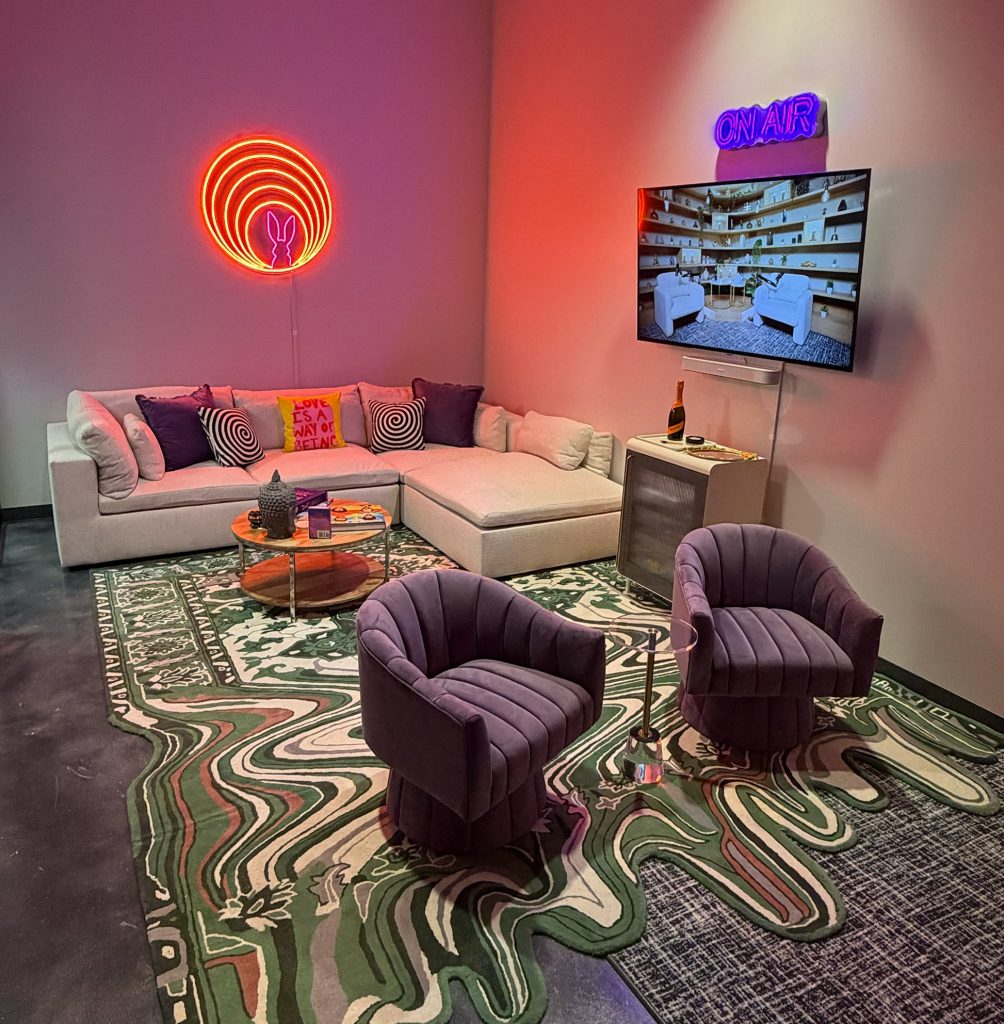
1. Kindly give our readers an introduction to your business. Please include what your business is all about, in which city you are located and if you have offices in multiple locations/cities.
Rabbit Hole Media Lab is a full-service podcast and video production studio with a dedicated sound booth for voiceover and audio recording, a membership-based coworking space, and a private event space and venue available for rent in East Austin, Texas. We are located at 507 Calles Street, just minutes from downtown Austin and Austin-Bergstrom International Airport.
We built Rabbit Hole for founders, creators, executives, podcasters, brands, companies, and communities that have something meaningful to say and want the quality of their content to match the quality of their ideas. Clients can record podcasts, film thought-leadership and social content, create educational or course material, record voiceover and other audio in our dedicated sound booth, and host panels, workshops, offsites, brand activations, intimate gatherings, and community events. Members can also use Rabbit Hole as a beautiful, thoughtfully designed place to cowork, meet, and connect.
Rabbit Hole is also full service. Depending on what a client needs, our team can support message development and pre-production, filming or recording, producer-led sessions, editing and post-production, social cutdowns, on-camera coaching, and visibility strategy. Clients can simply book the space and equipment, or they can ask us to help manage the entire creative and production process. Technically, the studio offers three-camera 6K production, cinematic lighting, professional audio, live-editing workflows, producer support, and flexible sets. But the heart of Rabbit Hole is the experience. We designed it to feel elevated, grounding, imaginative, and deeply human—a place where people can exhale, get out of their heads, and create work that actually feels like them.
2. Kindly give us a brief description about yourself. It should include your brief educational or entrepreneurial background and list some of your major achievements.
I am an award-winning storyteller, brand architect, entrepreneur, and investor with more than two decades of experience helping people, leaders, and organizations communicate with greater clarity, credibility, and emotional resonance.
My career has spanned startups, Fortune 500 organizations, agency leadership, brand strategy, executive visibility, and entrepreneurship. I’ve helped build and scale two eight-figure companies and have advised prominent CEOs, founders, and business leaders on how to articulate who they are, what they stand for, and why their work matters. Today, I am the founder of Rabbit Hole Media Lab, a Partner at Mindful Ventures, and the founder of Depuis, a women’s storytelling platform and movement where women share honest stories in their own words and on their own terms so that others can feel seen, understood, and less alone.
The through line across my entire career has been helping people be seen, heard, and remembered. Whether I am shaping a brand, supporting a founder, creating a studio experience, or building a platform for women’s stories, I am always trying to uncover what is most true and meaningful and help bring it into the world with intention.
3. What inspired you to start a new business venture? How did the idea for your business come about?
I often say that I accidentally built one of Austin’s coolest production studios, because Rabbit Hole did not begin with a grand plan to enter the studio business.
My husband had podcast and video equipment slowly taking over our house, and I wanted it out. At the same time, we had recently moved to Austin and were looking for office space for our marketing agency. The plan was simple: find an office, turn one room into a small podcast studio, and move on with our lives.
Then we walked into this space. It contained a brand-new, professionally built production studio that had never really been used. The build-out represented a significant investment, and the quality was immediately obvious. We knew we had found something far more special than the modest office-and-podcast-room concept we had imagined.
So instead of building a studio inside an office, we built everything else around the studio: offices, conference rooms, a green room, a lounge, coworking areas, an event space, a kitchen, and the jungle bar. I personally selected the rugs, art, furnishings, textures, and objects because I wanted every corner to feel intentional.
The business idea became bigger as I considered what had been missing from many production experiences I had encountered. People often focus on cameras, lights, and sound, but overlook how vulnerable it can feel to step in front of a camera and share something that matters. Rabbit Hole grew from the belief that world-class production and genuine care should exist in the same room.
4. What would you say are the top three skills needed to be a successful entrepreneur?
Passion and conviction: The work that resonates most deeply is usually the work you genuinely care about. People can feel the difference between something built from lived belief and something built simply because it appears commercially attractive. Passion does not replace strategy, but it gives the work a truth and energy that cannot be manufactured or faked.
Resilience: Entrepreneurship will test your confidence, patience, finances, relationships, and capacity to keep going. You have to be able to absorb disappointment, learn from it, and continue without allowing every setback to redefine what you believe is possible.
Emotional intelligence and adaptability: You need to understand people, listen beneath what they are saying, communicate clearly, and adjust when the information changes. A founder has to remain deeply committed to the purpose without becoming rigid about the exact path.
5. To what do you most attribute your success?
I attribute my success first to how deeply I care. I care about the quality of what I put into the world, but I care just as much about the people on the other side of it: how they feel, whether they feel understood, and whether the work truly reflects who they are and what they are trying to contribute.
Throughout my career, I have had an instinct for seeing what is meaningful in a person, a company, or an idea and helping other people see it too. The through line has always been helping people be seen, heard, and remembered. I do not think of storytelling or marketing as simply making something look good. At its best, it is about recognizing the truth and value in someone’s work, giving it language and form, and helping it reach the people who need it.
I am especially passionate about supporting founders, creators, brands, and organizations that are trying to make a positive impact. There are extraordinary people doing meaningful work who do not always know how to communicate it, position it, or give it the visibility it deserves. I love helping close that gap. When their ideas reach farther, more people can be helped, changed, inspired, or made to feel less alone.
I also attribute my success to the fact that when I believe in something, I give it everything. I am willing to obsess over the details, challenge the obvious answer, and keep refining until the work feels worthy of the idea behind it. That intensity has required me to learn boundaries and sustainability, but it has also been the source of some of the work I am proudest of.
Ultimately, I think my success has come from combining strategy with empathy. I can see the business opportunity, the story, and the human being at the same time. That combination has allowed me to build trust, create work with emotional resonance, and help people bring great things into the world in a way that feels true to them.
6. How do you go about marketing your business? What has been your most successful form of marketing?
We market Rabbit Hole through a combination of founder-led storytelling, organic social media, strategic partnerships, public relations, events, community-building, referrals, and direct relationship development. Because we are a visual and experiential business, we also use the studio itself as the marketing. When people walk in, attend an event, or see what was created here, they understand the difference much faster than they would from a list of equipment.
Our most successful form of marketing has been the experience people have with us and the word of mouth that follows. A beautifully produced piece of content can attract attention, but a client who felt prepared, welcomed, supported, and proud of the final work becomes an advocate. Community events and partnerships have also been powerful because they allow people to experience Rabbit Hole as more than a rental studio—it becomes a place they want to return to and bring others into.
7. What is the best way to achieve long-term success?
Long-term success comes from creating real value consistently while remaining willing to evolve.
A strong brand cannot compensate forever for a weak experience, and a beautiful product cannot compensate forever for an unsustainable business model. You need to understand your customer, protect the quality of what you deliver, know your numbers, build a capable team, and keep listening even after people begin praising you.
I also believe reputation compounds. Every interaction teaches people what to expect from you. Long-term success is built by making promises carefully, keeping them consistently, addressing mistakes quickly, and becoming the kind of business people trust when the stakes are high.
08. Excluding yours, what company or business do you admire the most?
I admire Aman because it understands that a premium experience is not created by adding more noise. It is created through restraint, consistency, design, service, and attention to how a person feels in the environment. One of the things I especially admire is how well they anticipate your needs, often before you have to ask. The product is not only the room or destination; it is the emotional experience.
That idea of anticipating someone’s needs is core to how I have modeled and operated Rabbit Hole and other businesses. The best experiences remove friction almost invisibly: the details have been considered, the person feels cared for, and they do not have to manage the experience themselves. That philosophy strongly resonates with how I think about Rabbit Hole.
9. How important have good employees been to your success?
Essential. A premium space and excellent equipment mean very little if the people delivering the experience are inattentive, rigid, or unkind.
At Rabbit Hole, team members are expected to notice what a client may need before the client has to ask. That can mean preparing the room correctly, helping someone feel at ease on camera, solving a technical issue quietly, or simply greeting people with genuine warmth. The team turns the brand promise into something a client can actually feel.
10. How long do you stick with an idea before giving up?
I separate the purpose from the method. I can stay committed to a meaningful purpose for a very long time, but I am willing to change the method quickly when the evidence shows it is not working.
Persistence is valuable, but stubbornness can become expensive. I ask: Is the underlying need still real? Are customers responding? Is the issue the idea itself, the timing, the offer, the pricing, or the execution? I do not abandon something because it becomes difficult, but I also do not romanticize struggle when the market is clearly giving me information.
11. What motivates you?
I am motivated by bringing meaningful ideas into form. I love taking something that exists only as a feeling, possibility, or vision and making it tangible—whether that is a brand, a room, a story, an event, or a business.
I am also deeply motivated by seeing people become more fully themselves. When someone walks into Rabbit Hole nervous or uncertain and leaves feeling clearer, more confident, and proud of what they created, that is incredibly energizing to me. I also love creating experiences for people and then watching them enjoy them—seeing the awe, excitement, or delight that comes from discovering something new, stepping into a beautiful space, or experiencing an idea brought to life in a way they did not expect. There is something deeply rewarding about creating something that makes someone light up.
12. What are your ideals?
Depth over noise. Care without complacency. Excellence without ego. Beauty with purpose. Truth over performance.
At Rabbit Hole, our guiding ideas include clarity, courage, expression, and expansion. I want the work to be beautiful, but not empty; strategic, but not sterile; ambitious, but not dehumanizing. The ideal is to create an environment where people can do exceptional work and still feel like human beings while doing it.
13. How do you generate new ideas?
Most of my ideas begin with attention. I notice where people feel friction, where an experience becomes unnecessarily cold or complicated, and where the existing options do not reflect what people actually want.
I also generate ideas by asking better questions: What would make this easier? What would make it feel more meaningful? What are we accepting as normal that does not have to be? What would I create if I were not trying to imitate what already exists?
Travel, design, conversations, art, community experiences, and time away from a screen all help me connect patterns that may not look related at first.
14. How do you build a successful customer base?
You build trust one experience at a time. Be clear about who you serve, solve a problem that matters, deliver what you promised, and make people feel respected throughout the process.
At Rabbit Hole, we focus on the full journey—from the first inquiry and preparation to the moment a client arrives, records, receives the files, and decides whether to return. A customer base becomes strong when people do not merely like the product; they trust the people behind it and are comfortable attaching their own reputation to a referral.
15. What is your favorite aspect of being an entrepreneur?
My favorite part is turning imagination into reality. I love having an idea in my head, whether it is a space, a brand, a business, an experience, or simply a feeling I want someone to have, and then figuring out how to actually build it into something real.
Entrepreneurship gives me the freedom to question what already exists, imagine what could be better, and then bring together the people, resources, creativity, and courage to make it happen. There is something incredibly satisfying about standing inside something that once existed only in your imagination and then watching other people experience it, use it, and enjoy it.
16. What has been your most satisfying moment in business?
Some of the most satisfying moments at Rabbit Hole are surprisingly quiet. It is when someone walks in and says, “This feels like home,” or tells us that they immediately feel better simply being in the space.
It is also watching a founder who was tense about being on camera settle into the conversation, forget the performance, and say what they actually came to say. The finished video matters, but that shift in the person matters just as much to me.
17. What do you feel is the major difference between entrepreneurs and those who work for someone else?
The deepest difference is the relationship to responsibility and ambiguity. Entrepreneurs have to make decisions before they have complete information, and they cannot outsource the ultimate responsibility for the consequences.
That does not mean entrepreneurs are inherently more courageous or valuable than employees. Great organizations need both. But entrepreneurship requires a particular willingness to create structure where none exists, absorb uncertainty, and continue moving when there is no one above you to provide the answer.
18. What kind of culture exists in your organization? How did you establish this tone and why did you institute this particular type of culture?
Rabbit Hole has a high-care, high-standard culture. We are warm, attentive, flexible, and human, but we are also serious about preparation, communication, technical quality, and follow-through.
I established that tone by being explicit about what matters and by modeling it. Details are not “extra” here. How the room looks, how a client is greeted, whether the team anticipates a problem, and whether someone feels rushed all communicate the value we place on the person and the work.
I chose this culture because creative work requires trust. People take better risks, communicate more honestly, and create stronger work when they feel both supported and held to a meaningful standard.
19. In one word, characterize your life as an entrepreneur.
Devoted.
20. If you had the chance to start your career over again, what would you do differently?
I would trust my own voice sooner, build operational systems earlier, and stop equating being indispensable with being effective.
For a long time, I believed that caring deeply meant carrying everything. Experience has taught me that leadership is not proving how much you can hold; it is creating clarity, choosing the right people, and building a structure in which excellence does not depend on your exhaustion.
21. How has being an entrepreneur affected your family life?
Entrepreneurship has made work and family life more intertwined, sometimes in funny and unexpected ways. Rabbit Hole literally began because my husband’s production equipment was taking over our house.
Building the studio became a shared adventure, but it has also reinforced the need for boundaries. When you are married to another ambitious person and building multiple things, there will always be another idea, problem, or opportunity to discuss. We have to be intentional about being partners in life, not only partners in problem-solving.
22. Do you believe there is some sort of pattern or formula to becoming a successful entrepreneur?
There is no universal formula, but there are repeatable patterns: solve a meaningful problem, understand the customer, communicate a clear value proposition, manage cash carefully, hire people who strengthen your weaknesses, and adapt before circumstances force you to.
The less glamorous pattern is consistency. Many businesses do not fail because the founders lacked talent. They fail because the offer was unclear, the numbers were avoided, the customer experience was inconsistent, or the founder kept changing direction before anything had time to compound.
23. Who has been your greatest inspiration?
I am continually inspired by people who have lived through difficulty and still choose to create beauty, build community, and remain open-hearted.
Professionally, I am inspired by founders and leaders who refuse the false choice between performance and humanity—people who build successful companies while staying connected to meaning, responsibility, and the lives affected by their decisions.
24. What book has been inspiring for you?
One book that has been inspiring for me is The Surrender Experiment by Michael Singer. What resonates with me is the idea of loosening our grip on how we think life is supposed to unfold and becoming more open to what life is actually presenting.
I have spent a lot of my life being a builder—making things happen, solving problems, creating plans, and pushing ideas forward. The book has challenged me to think about the difference between intentional action and trying to control every outcome. To me, surrender is not passivity. It is staying engaged, doing the work, and also trusting timing, paying attention to what is unfolding, and being willing to let the path become something different—and sometimes better—than what you originally planned.
25. What are your hobbies? What do you do in your non-work time?
I love travel, interiors and design, wellness experiences, discovering beautiful spaces, and bringing interesting people together. I am naturally curious, so even my downtime often involves exploring a new idea, place, tradition, or way of seeing the world.
I also value time with my husband, close friends, and our dogs, Obi-Wan and Luna Bean. The most restorative moments are often the simplest ones: a meaningful conversation, a beautiful meal, time outside, or being somewhere that helps me become fully present.
26. What sacrifices have you had to make to be a successful entrepreneur?
Entrepreneurship has required me to sacrifice certainty, comfort, time, and at different points, financial predictability. It has also required me to accept that not everyone will understand a decision before the result exists.
I do not believe sacrifice should be romanticized. Burnout is not a business strategy. The goal is to make conscious sacrifices for a defined season and purpose—not to build a life in which the business permanently consumes everything else.
27. If you were conducting this interview, what question would you ask?
I would ask: “How do you want people to feel when they leave, and what have you intentionally built to create that feeling?”
For Rabbit Hole, the answer is that I want people to leave feeling more seen, more heard, more confident, and more connected to what they came to say. We built that feeling through the physical environment, the production quality, the preparation, the team’s attentiveness, and the belief that a person’s story is never merely content.
28. What makes Rabbit Hole different from other podcast and video studios in Austin?
Rabbit Hole combines full-service production with a hospitality mindset. Many studios can provide equipment or an empty room; our difference is the way the environment, team, and process work together to help people perform at their best without feeling like they are being processed through a rental facility.
We offer cinematic three-camera 6K production, live-edit workflows, professional audio, producer support, flexible sets, editing and post-production, content strategy, on-camera support, and brand visibility guidance. At the same time, clients enter a multi-room, design-forward space with a green room, lounge, conference rooms, private offices, kitchen, membership-based coworking areas, a dedicated sound booth for audio recording, and a private event space and venue available for rent. The result is both technically serious and emotionally welcoming.
29. Who is the ideal Rabbit Hole client?
The ideal client is a founder, executive, podcaster, coach, artist, creator, company, or community with a meaningful message and a desire to present it with greater clarity and quality.
They do not need to arrive as a polished on-camera personality. They may need help clarifying the message, finding the hook, structuring the conversation, or becoming comfortable enough to speak naturally. What matters most is that they care about the work and want the final content to have substance as well as visual impact.
30. What can someone create at Rabbit Hole?
Clients use Rabbit Hole for video podcasts, interview shows, founder stories, executive thought leadership, social media content, brand campaigns, course and educational videos, panels, voiceover and other audio recording in our dedicated sound booth, testimonials, livestreams, event capture, internal communications, media days, and full content-production days.
Because the venue and studio exist together, a brand can also host a workshop, offsite, panel, activation, or community event while capturing professional content that extends the value of the gathering long after the room clears.
31. What does full service mean at Rabbit Hole?
Full service means clients do not have to assemble a different team for every stage of a project or manage all of the moving pieces alone. Depending on the scope, we can support concept and message development, pre-production, set selection, lighting and audio, filming or recording, an on-site producer, live-edit workflows, editing and post-production, social-media cutdowns, on-camera coaching, and visibility strategy.
Some clients need a beautiful, professionally equipped space and a strong production team for the day. Others want Rabbit Hole to help carry the project from the first idea through the final deliverables. We can meet them at either end of that spectrum and build the right level of support around the work.
32. What does “creative sanctuary” mean in practical terms?
It means the space is designed to reduce friction and support attention. The room is prepared. The technology is handled. The team is present without being intrusive. The client is not rushed into performing before they feel grounded.
“Sanctuary” does not mean lowering the professional standard. It means creating the conditions in which people can do their strongest work: beauty, preparation, privacy, warmth, technical precision, and enough psychological safety to say something real.
33. Why is community part of the business model?
Creative work becomes stronger when people are connected to relationships, ideas, and opportunities beyond a single transaction. Through membership, people can use Rabbit Hole as a place to cowork, meet, and build relationships. We also host workshops, founder gatherings, wellness experiences, private communities, panels, brand activations, and other events because we want the space to be alive—not simply booked by the hour.
Community also creates natural collaboration. A person may come to record a podcast and later meet a partner, client, expert, or friend through an event in the same space. That kind of ecosystem cannot be created through equipment alone.
34. How do you measure a successful client experience?
The obvious measures are production quality, efficiency, on-time delivery, repeat bookings, referrals, and whether the content performs its intended role. But we also listen for human measures: Did the client feel prepared? Did they feel respected? Did they sound like themselves? Are they proud to share what they created? Did the process give them momentum instead of draining it?
The best result is not merely a beautiful file. It is content the client is genuinely ready to put into the world.